A decade of proven performance: from research infrastructure to the future of Urban AI
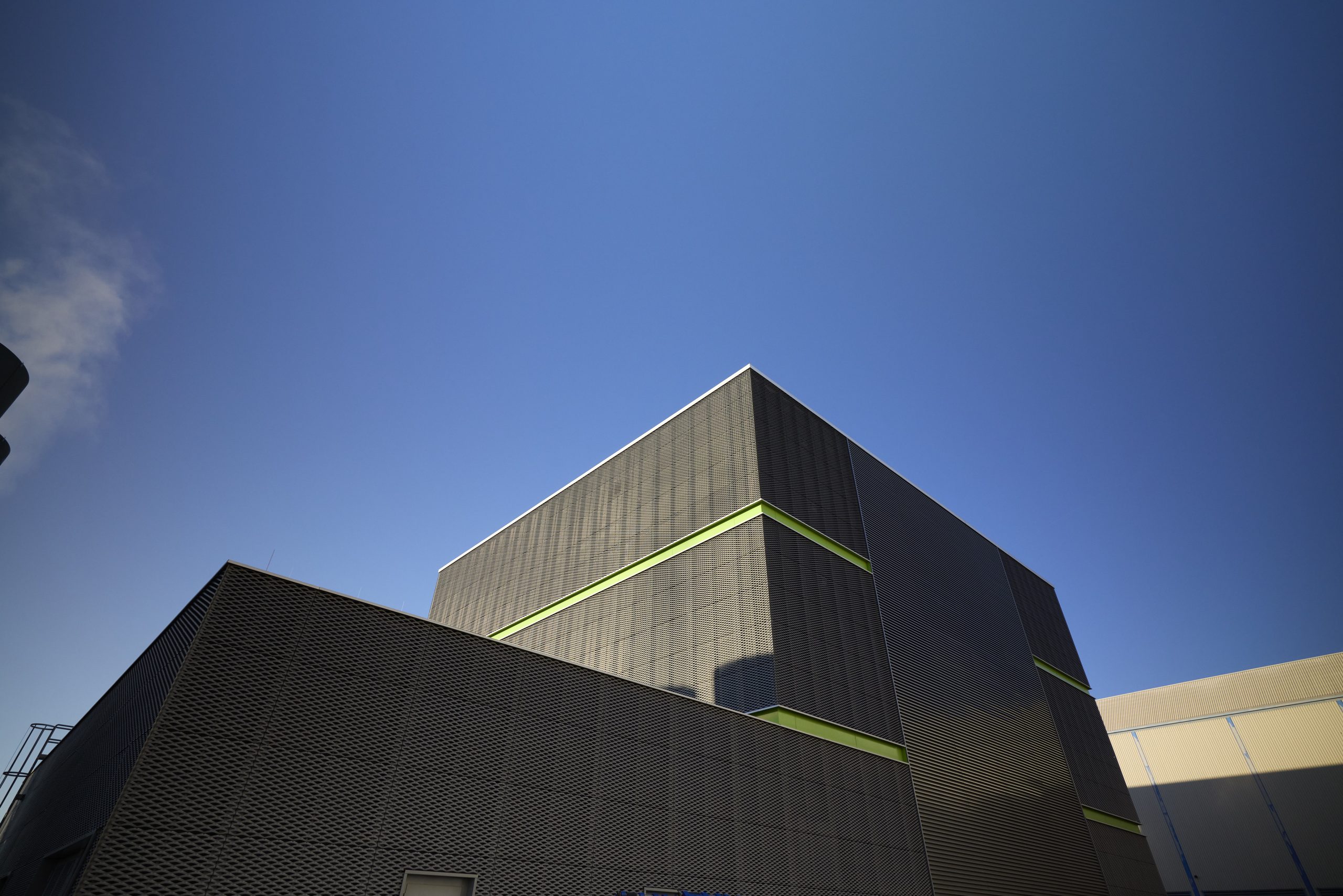
The Green IT Cube in Darmstadt represents more than a building. It has become a reference point for energy-efficient, high-density computing infrastructure.
Developed through collaboration between GSI Helmholtz Centre for Heavy Ion Research and Goethe University Frankfurt, the facility demonstrates how research-driven innovation can be translated into operational data center technology and sustained under real-world conditions.
The Green IT Cube concept was developed under the leadership of Professor Volker Lindenstruth with a clear objective: fundamentally improve efficiency in high-performance computing environments.
The approach focused on reducing cooling energy demand by integrating building structure, rack layout, and water-based cooling into a single coordinated system.
The unique combination of building design and cooling technology was a defining innovation and secured patent protection in Europe and internationally.
The Green IT Cube was constructed on the GSI campus in Darmstadt and commissioned in 2015. Built within approximately one year, the facility was designed to support large-scale scientific computing workloads and later became part of the infrastructure supporting FAIR (Facility for Antiproton and Ion Research).
Now, after more than a decade of continuous operation, the facility provides long-term validation of its original design principles.
Key performance characteristics include:
- Integrated water cooling at rack level
- High IT density capability (up to approximately 35 kW per rack)
- Free cooling operation
- Highly efficient infrastructure-to-whitespace ratio
- PUE of 1.07
The concept achieved significantly lower energy consumption compared to conventional data center designs. Waste heat generated by the facility is reused on campus to heat nearby buildings.
The Green IT Cube received the German Federal Government’s Blue Angel eco-label, becoming the first data center to receive this certification for environmental performance in both design and operation.
The project has also received multiple industry awards for innovation in energy-efficient high-performance computing, reinforcing its position as a benchmark for sustainable infrastructure.
Following successful patenting and operational validation, GARBE.DC secured the rights to commercialize the technology globally. This marked the transition from research-driven infrastructure to scalable commercial application.
In 2023, GSI and GARBE.DC further expanded their collaboration through the Digital Open Lab initiative. The platform enables joint research and testing with industrial and academic partners (including hessian.ai, NVIDIA and Rittal) to further refine sustainable data center technologies and prepare them for broader market deployment.
The operational experience gained over the past decade now directly informs the next phase of development.
The principles established in Darmstadt (integrated cooling, modular construction, and high-density computing capability) are being further developed to meet the evolving requirements of AI workloads and urban deployment environments, where space constraints, power availability, and sustainability considerations are increasingly critical.
Current development activities at GARBE.DC focus on translating this proven model into flexible, commercially deployable data center architectures for urban applications, while maintaining the original commitment to energy efficiency and resource optimization.
A decade of proven performance has created a foundation: not just for reflection, but for what comes next.